

SAMUEL LOVEJOY
BIRTH:
September 11, 1753
DEATH:
September 13, 1822
BURIAL:
Southeast Woodline,
Old Cemetery Section
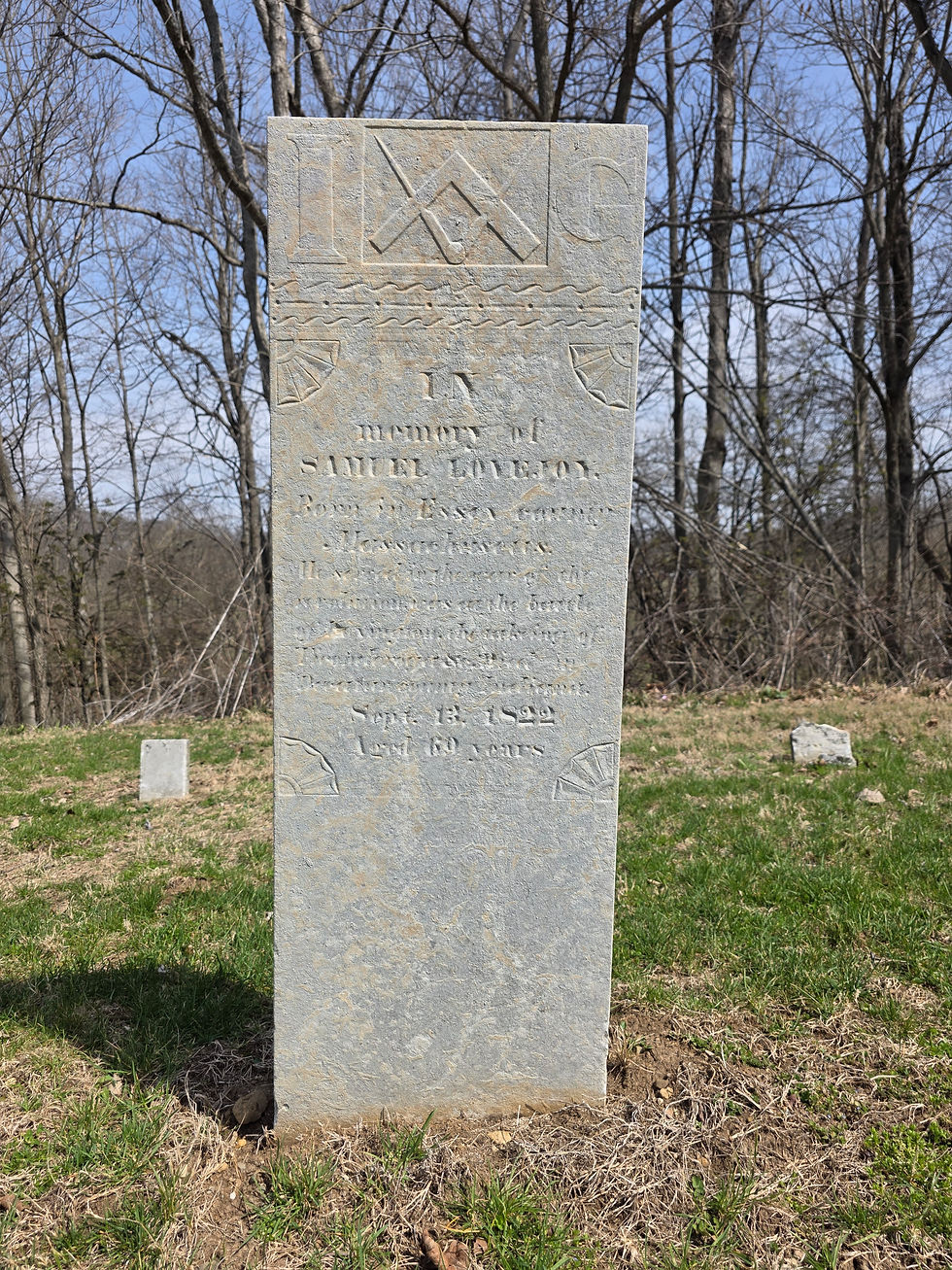
IN
MEMORY of
SAMUEL LOVEJOY
Born in Essex County
Massachusetts
He served in the war of the
Revolution, was at the battle
of Lexington, the taking of
Ticonderoga, Died in
Decatur County Indiana
Sept 13, 1822
Aged 69 Years
Samuel Lovejoy (1753 - 1822)
Revolutionary War Patriot - 5th Generation American - Frontier Pioneer
Buried in Star Cemetery, Adams Township, Decatur County, Indiana
Samuel Lovejoy was the first-born son and second born of 9 children of Issac Lovejoy and Deborah Sheldon. He was born in Andover, Essex County, Massachusetts, British Colonial America. He was named in honor of his grandfather, Samuel Lovejoy, a respected man in the town and the son of Lieutenant William Lovejoy. They were part of a line of New England Freeman whose story had been unfolding in Massachusetts for over a century. From the very beginning, Samuel was born into a legacy of public service, military sacrifice, and leadership.
That legacy began with Samuel's great-great grandfather, John Lovejoy, who arrived in the Massachusetts Bay Colony in 1638. John was a 17-year-old indentured servant when he stepped onto the shores of the New World, but he would go on to help shape it. He became one of the first settlers of Andover and served as the town's constable, a position of considerable authority. John owned a vast estate that was located on the road from Ipswich to Andover, known as Lovejoy's Lane. John also established the first iron works, sawmill, and gristmill in the area, laying the industrial and economic foundation that helped Andover survive and thrive. John Lovejoy carried the family's leadership into military and civic service. He served in King Philips War defending the colonial settlements against native resistance in one of the bloodiest conflicts of the 17th century, alongside three of his sons, John Jr. Christopher, and Lieutenant William.
Lieutenant William Lovejoy born April 21,1651 He was the first born of 12 children and was a tall man dark in complexion. He inherited his father's land along with the Lovejoy Ironworks and Mills. He was a key figure in keeping Andover intact during the dangerous frontier years. William held a respectable role in the Puritan church as a Deacon. He was a farmer and a maker of shoes. William was the father of at least eight children. Among them was Samuel's great uncle Captain William Jr., a man remembered for his extraordinary act of justice. In 1748, Captain William famously gave his slave Pompey his last name, granted him freedom, and gave him a 31-acre parcel of land with a pond to build a home. This was eighteen years before slavery was abolished in Massachusetts, and the land is still known today as Pomps Pond.
Samuel's grandfather, Samuel Lovejoy, the man for whom he was named, was the sixth born of Lieutenant William. Samuel continued the family's civic minded legacy in Andover. He was in the militia as was required at the time for landholders. His life bridged the colonial wars and the early stirrings of revolution. Samuel married his second Cousin Hannah Stevens and they had ten children, two of their sons were non-compos mentis, and one was left to the care of his second born son, Issac, upon Samuel's death.
Issac Lovejoy was born in 1723 and served first in the French and Indian War during the 1750's. He was a yeoman, a working landowner, and a man of both means and humility. He fought to defend colonial interests against French and Native forces along the northern frontier, returning to Andover to raise a large family. When the Revolution came, Issac was 52 years old when he enlisted again, this time to fight for independence from Britain. He joined Captain Joseph Butler's Company, part of Colonel John Nixon's 5th Massachusetts Regiment, and stood at the Battle of Bunker Hill on June 17, 1775. His son Samuel had joined earlier that spring.
Samuel Lovejoy was born September 11, 1753, and he was the first born son and second born of 9 children and was raised on the Lovejoy estates. He was 21 when he marched on the Alarm of April 19, 1775, to Cambridge, in direct response to the events at Lexington and Concord. He was among the first to take up arms in defense of American liberty. In the months that followed he participated in the capture of Fort Ticonderoga and the Battle of Bunker Hill. Samuel Lovejoy is recorded on page 997 Volume IX Massachusetts Soldiers and Sailors of the Revolution who served as follows: Private, Captain Joshua Holt's Fourth Andover Company; also Captain Samuel Johnson's Company, Colonel Wigglesworth's Regiment in March of 1777 that lists Samuel Lovejoy "now of Pepperell." He was a private in Captain Asa Lawrence's Company, Colonel William Prescott's Regiment, also a private in Captain Nathaniel Larkin's Company, Colonel John Robertson's Regiment in Rhode Island and later at North Kingston, 1777. This service was authenticated by Secretary of State E.M. Wright of Massachusetts June 27, 1853. this authentication is now in the hands of Thaddeus Lovejoy of Washington, D.C. Samuel's service at the "Northward" and his travel from Albany and his participation at Lexington and Bunker Hill are recorded in the Massachusetts Revolutionary Archives.
Samuel Lovejoy married Esther Morse in Methuen, Massachusetts on March 1, or November 27, 1788. Esther was the daughter of Captain William Morse and Phebe Stevens Bodwell. Family history says she was related to Samuel F. B. Morse, inventor of the telegraph. Samuel and Esther's daughter Nancy (Lovejoy) Watson was born in Methuen on August 21, 1789.
Samuel Lovejoy is documented in Franklin County, Indiana in 1816, placing him in the region during the earliest years of Indiana statehood. It remains a possibility that he was present in the area before the lands of the new purchase opened for federal sale in 1820. It is known that he settled on the banks of the Little Flatrock River in the vicinity of what is now Star Cemetery in Adams Township. His presence on this waterway places him among the earliest known settlers connected to this landscape and suggests that he recognized the strategic value of the river corridor for settlement, travel, and future community development.
This location is historically significant because the Little Flatrock River later became the site of the Jewett Mill, one of the most important early economic centers in the community. Given Samuel's early settlement near the future mill location, it is entirely possible that he was living in the immediate vicinity long before the formal development of the site by David Jewett and his investors. Early frontier settlers were naturally drawn to waterways for fertile land, dependable water, transportation routes and the possibility of water powered enterprise. Samuel's choice of location may have been both practical and strategic.
It is also possible that the land on which Samuel settled was later incorporated into acreage purchased by John Shelhorn after the New Purchase lands opened for sale. On the Indiana frontier, early residents often occupied or improved land before the formal patents were issued, and later purchasers frequently acquired tracts that had already been recognized as valuable by earlier settlers. If Samuel had established a cabin, clearing or farmstead along the Little Flatrock River, his presence may have helped identify the long-term importance of this particular site.
Another compelling possibility lies in Samuel Lovejoy's potential influence on the selection of the future mill location. If he carried practical knowledge or family heritage connected to mills and river sites, he may have been among the first to recognize the advantages of this stretch of the Little Flatrock River. The siting of a frontier mill required careful observation of water flow, elevation, and year-round reliability, knowledge often held by those who had lived closest to the river the longest. It is therefore historically reasonable to consider that Samuel's familiarity with the land may have contributed, directly or indirectly, to the later decision by David Jewett and his investors to establish the mill at that location.
His story also fits within the broader historical pattern of the early republic's use of Revolutionary War veterans and their families to strengthen the frontier. In the years following the war, veterans were often encouraged to move westward through land opportunities, particularly in neighboring Ohio, where military districts were established as compensation for service and as a means of creating stable settlement zones. Although no land grant has yet been identified in Samuel's name, the presence of his son in neighboring Ohio, near the border of the New Purchase suggests that the family may have been positioned along this line of westward migration and frontier protection.
Taken together, these possibilities suggest that Samuel Lovejoy may have played a far greater role in the early history of Adams Township than surviving records can presently confirm.
Samuel Lovejoy died September 13, 1822, in Adams Township, Decatur County Indiana.
Although there are several small, unmarked stones behind Samuel on the edge of the woods, he is the first known burial in the Little Flatrock Cemetery. Samuel's daughter Nancy died 13 years later and is buried beside her father with a matching stone. Esther died in 1854 in Decatur County, but her final resting place remains unknown.


Comments